
What Size Furnace Do I Need for My Chicago Home?
Choosing the right furnace size for your Chicago home matters more than most homeowners realize. A furnace that is too small may struggle during freezing weather. A furnace that is too large may short cycle, waste energy, create uneven temperatures, and wear out faster.
At Bean’z Heating & Cooling, we help Chicago homeowners understand furnace sizing before they replace their heating system. The right furnace is not just about square footage. It depends on your home’s insulation, windows, ceiling height, ductwork, basement, airflow, and how much heat the home loses during cold weather.
For help with furnace replacement or installation in Chicago, call Bean’z Heating & Cooling at 312-593-6334.
Why Furnace Size Matters
Your furnace size is usually measured in BTUs, which stands for British Thermal Units. BTUs measure how much heat the furnace can produce.
A properly sized furnace should heat your home comfortably without running too short or too long.
When the furnace is sized correctly, you get:
- Better comfort
- More even heating
- Lower system strain
- Better airflow
- Fewer breakdowns
- Longer equipment life
- More efficient operation
When the furnace is sized wrong, problems can show up fast.
Why Square Footage Alone Is Not Enough
A lot of homeowners ask, “How many BTUs do I need for my square footage?”
That is a fair question, but square footage is only the starting point. Two Chicago homes with the same square footage can need different furnace sizes.
For example, an older brick bungalow with drafty windows may need more heating capacity than a newer insulated home of the same size. A home with poor ductwork may also feel colder even if the furnace has enough BTUs.
That is why a professional should look at the whole system before recommending furnace size. A room-by-room heating-load calculation, commonly called an ACCA Manual J calculation, is the best way to estimate how much heat the home loses under Chicago winter design conditions.
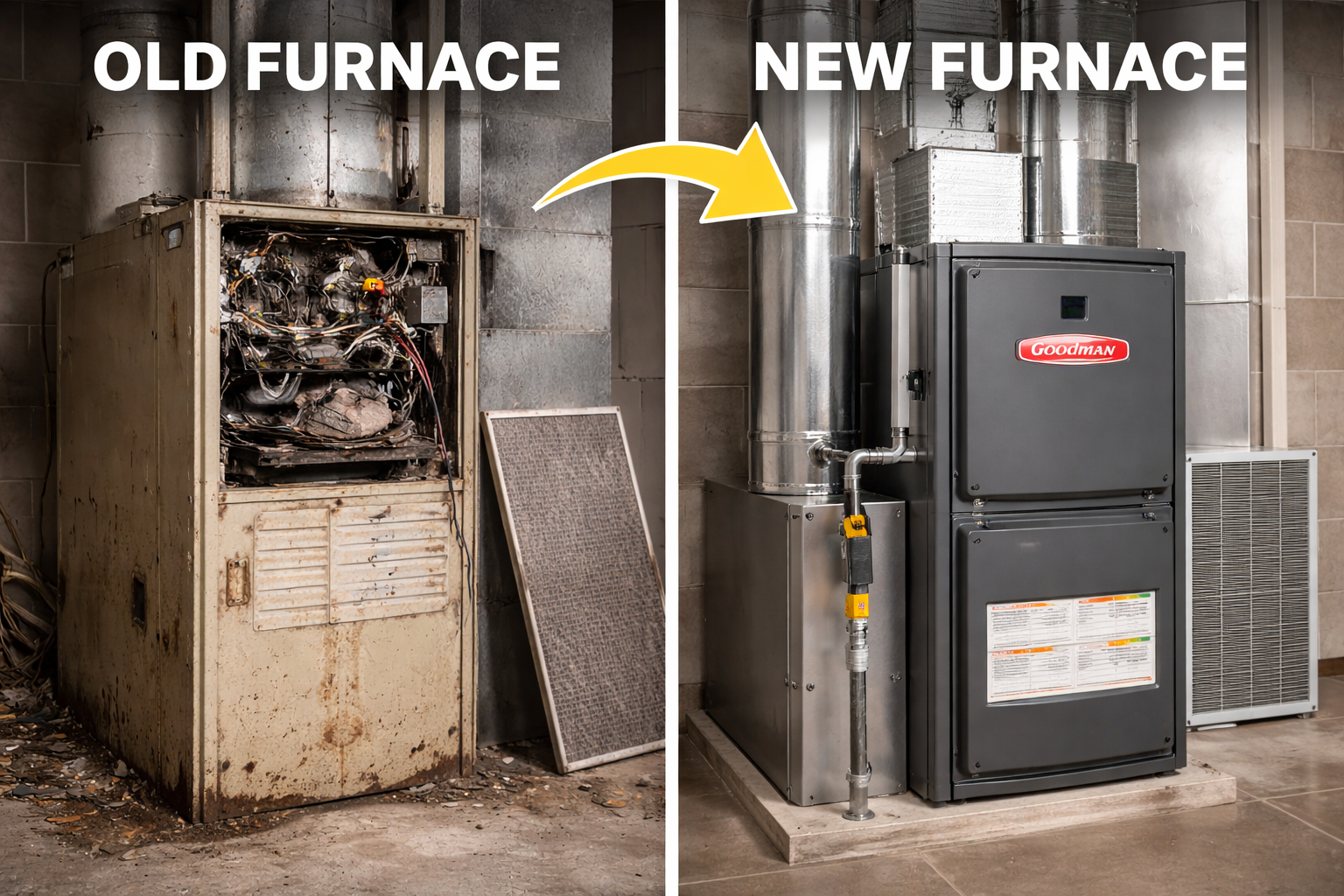
Rough Furnace Size Chart for Chicago Homes
This chart gives a general idea, but it should not replace a proper heating-load calculation.
| Home Size | Rough Furnace Size Range |
|---|---|
| 800–1,000 sq. ft. | 40,000–60,000 BTU |
| 1,000–1,400 sq. ft. | 60,000–80,000 BTU |
| 1,400–1,800 sq. ft. | 70,000–90,000 BTU |
| 1,800–2,200 sq. ft. | 80,000–100,000 BTU |
| 2,200–2,800 sq. ft. | 90,000–120,000 BTU |
This is only a rough guide. Your actual furnace size can change depending on insulation, windows, ductwork, ceiling height, home layout, air leakage, and furnace efficiency.
Chicago Weather Makes Furnace Sizing Important
Chicago winters can be rough. When temperatures drop, your furnace has to work hard to keep the home comfortable.
That does not mean bigger is always better. A furnace should be sized to match the home’s heating load. Oversizing the furnace can cause just as many problems as undersizing it.
In older Chicago homes, heat loss can come from:
- Old windows
- Poor attic insulation
- Basement air leaks
- Drafty doors
- Leaky ductwork
- Poor return airflow
- Uninsulated walls
- Old or restricted vents
Before replacing a furnace, these issues should be considered.
Signs Your Furnace May Be Too Small
A furnace that is too small may run constantly and still not keep up.
Common signs include:
- The house never reaches the thermostat setting
- The furnace runs almost nonstop in cold weather
- Back rooms stay cold
- Upstairs and downstairs temperatures feel uneven
- Utility bills are high
- The home takes too long to warm up
But don’t assume the furnace is too small right away. Dirty filters, weak blower motors, duct problems, thermostat issues, and poor insulation can create similar symptoms. Following a regular Chicago HVAC maintenance plan can help catch restrictions and weak components before they cause a no-heat call.
That is why a real furnace diagnostic matters.
Signs Your Furnace May Be Too Big
A bigger furnace sounds good, but oversized furnaces can create comfort problems.
Signs of an oversized furnace include:
- The furnace turns on and off quickly
- Rooms heat unevenly
- The home gets hot fast but cools down quickly
- The furnace short cycles
- The system is noisy
- Higher wear on parts
- Poor humidity comfort in winter
Short cycling is hard on the system. It can wear out ignition parts, blowers, control boards, and other components faster.
80% vs. 90% Furnace Sizing
Furnace efficiency and AFUE ratings matter when choosing size.
An 80% furnace sends about 80% of the heat into the home and loses the rest through the flue.
A 90%+ high-efficiency furnace sends more heat into the home and vents differently, usually through PVC pipe.
For example:
- An 80,000 BTU 80% furnace gives about 64,000 BTUs of usable heat.
- An 80,000 BTU 96% furnace gives about 76,800 BTUs of usable heat.
That is why you cannot compare furnaces only by the input BTU number. The output BTU matters too.
For more help comparing systems, visit our furnace installation in Chicago page.
Ductwork and Airflow Matter Too
Even the right furnace will not perform well if the ductwork is wrong.
Your ducts need to move the right amount of air across the furnace. If the ducts are too small, restricted, leaking, or poorly designed, the system may have comfort problems.
Ductwork issues can cause:
- Weak airflow
- Noisy operation
- Furnace overheating
- Limit-switch problems
- Uneven room temperatures
- Higher energy bills
- Short cycling
Before replacing your furnace, the ductwork and return air should be checked. ENERGY STAR explains how duct leakage can reduce comfort and waste conditioned air.
Should You Replace the Furnace or Repair It?
Not every furnace problem means replacement. Sometimes the issue is a repairable part, dirty flame sensor, pressure-switch problem, thermostat issue, blower problem, or airflow restriction.
But replacement may make more sense when:
- The furnace is very old
- Repairs are becoming frequent
- Heat-exchanger safety is a concern
- Parts are expensive or hard to find
- The system is oversized or undersized
- Utility bills keep rising
- Comfort problems keep coming back
For more help deciding, read our furnace repair vs. replace guide.
How Bean’z Heating & Cooling Helps Size a Furnace
When we look at furnace replacement, we do not just guess by square footage. We look at the home and system setup.
We check things like:
- Current furnace size
- Home square footage
- Insulation condition
- Basement and attic conditions
- Window condition
- Ductwork and airflow
- Return-air setup
- Venting requirements
- Thermostat location
- Heating comfort complaints
- System age and repair history
The goal is to recommend a furnace that fits the home, not just sell the biggest unit.
Don’t Buy a Furnace Based Only on Price
A cheap furnace installation can cost more later if the size is wrong or the installation is rushed.
A proper furnace installation should include:
- Correct equipment sizing
- Safe gas connection
- Proper venting
- Drain setup if high efficiency
- Thermostat setup
- Airflow check
- Filter check
- Startup testing
- Safety inspection
For cost information, visit our furnace replacement cost in Chicago guide.
Furnace Sizing FAQ
What size furnace do I need for a 1,200 sq. ft. house?
A 1,200 sq. ft. Chicago home may need somewhere around 60,000 to 80,000 BTUs, but that depends on insulation, windows, ductwork, air leakage, and home layout.
Is a bigger furnace better?
No. A furnace that is too large can short cycle, waste energy, create uneven heating, and wear out faster.
Can my old furnace size tell me what size I need?
It helps, but it should not be the only thing used. The old furnace may have been oversized or undersized from the start.
Why is my house cold if my furnace is big enough?
The problem may be airflow, ductwork, dirty filters, thermostat location, insulation, or a repair issue. You may need furnace repair in Chicago instead of replacement.
Should I tune up my furnace before replacing it?
If the furnace is still safe and not too old, a tune-up may help confirm whether the system needs repair or replacement. Schedule a furnace tune-up in Chicago before winter if you are unsure. You can also review the ENERGY STAR heating and cooling maintenance checklist.
Call Bean’z Heating & Cooling for Furnace Sizing Help
Not sure what size furnace your Chicago home needs? Don’t guess. The right furnace size depends on your home, ductwork, airflow, insulation, and comfort needs.
Call Bean’z Heating & Cooling at 312-593-6334 for furnace installation, furnace replacement, furnace repair, and heating service in Chicago.
You can also request service online.