
Cooling-system troubleshooting for Chicago homes
AC Repair Chicago IL
AC Repair Chicago IL service begins by tracing the failure through the thermostat, indoor airflow, evaporator coil, drain system, outdoor electrical components, compressor circuit, and refrigerant-side operation. You receive the finding and repair price before additional work begins.
Before the service visit
AC Repair Chicago IL: Protect the System and Property
Before requesting AC Repair Chicago IL service, a few observations are useful, but do not keep resetting a breaker, chip ice from a coil, open a refrigerant circuit, or bypass a safety control. Use the symptom to decide whether the AC should remain off.
Water near the furnace or air handler
Turn cooling off when water threatens ceilings, flooring, finished walls, or electrical parts. Note whether the drain, pump, pan, or indoor coil area appears wet.
Ice on copper or the indoor coil
Turn cooling off and allow the system to thaw naturally. Keep the fan on only if it can operate safely and there is no water threat. Do not scrape or heat the ice.
Breaker trips more than once
Leave the circuit off after a repeated trip. A breaker, wire, motor, compressor, capacitor, or other electrical condition needs testing before another reset.
Burning odor or heavy buzzing
Stop the system. A hot connection, stalled motor, damaged contactor, failed capacitor, or other electrical fault can worsen while energized.
Blower runs but outdoor unit is silent
Set the thermostat to off until the outdoor circuit can be checked. Running indoor air alone will not restore mechanical cooling.
No immediate hazard, but no cooling
For AC Repair Chicago IL availability, check the thermostat setting and filter, then call with the system status. Same-day service may be available after the schedule and travel area are confirmed.
Follow the cooling path
AC Repair Chicago IL Starts With the Symptom
During AC Repair Chicago IL diagnosis, we evaluate two connected sections of the central air system. Indoors, the blower must move enough return air across the evaporator coil and deliver conditioned air through the supply ducts. Outdoors, the condenser fan and compressor must reject heat while the refrigerant circuit moves heat between both coils.
That is why “warm air” is not a diagnosis. The thermostat may not be sending the correct call, the blower may be moving too little air, the outdoor unit may have an electrical failure, the coils may be dirty, the drain or safety switch may have opened, or refrigerant-side operation may be outside the expected range.
- Thermostat call and low-voltage controls
- Filter, blower, supply and return airflow
- Evaporator-coil and drain condition
- Outdoor disconnect and power
- Contactor, capacitor and motor response
- Compressor starting and operating behavior
- Temperature and refrigerant-side indicators
- Duct and room-by-room comfort pattern
When the equipment is operating but airflow cannot reach the rooms, review our Chicago ductwork and static-pressure service.
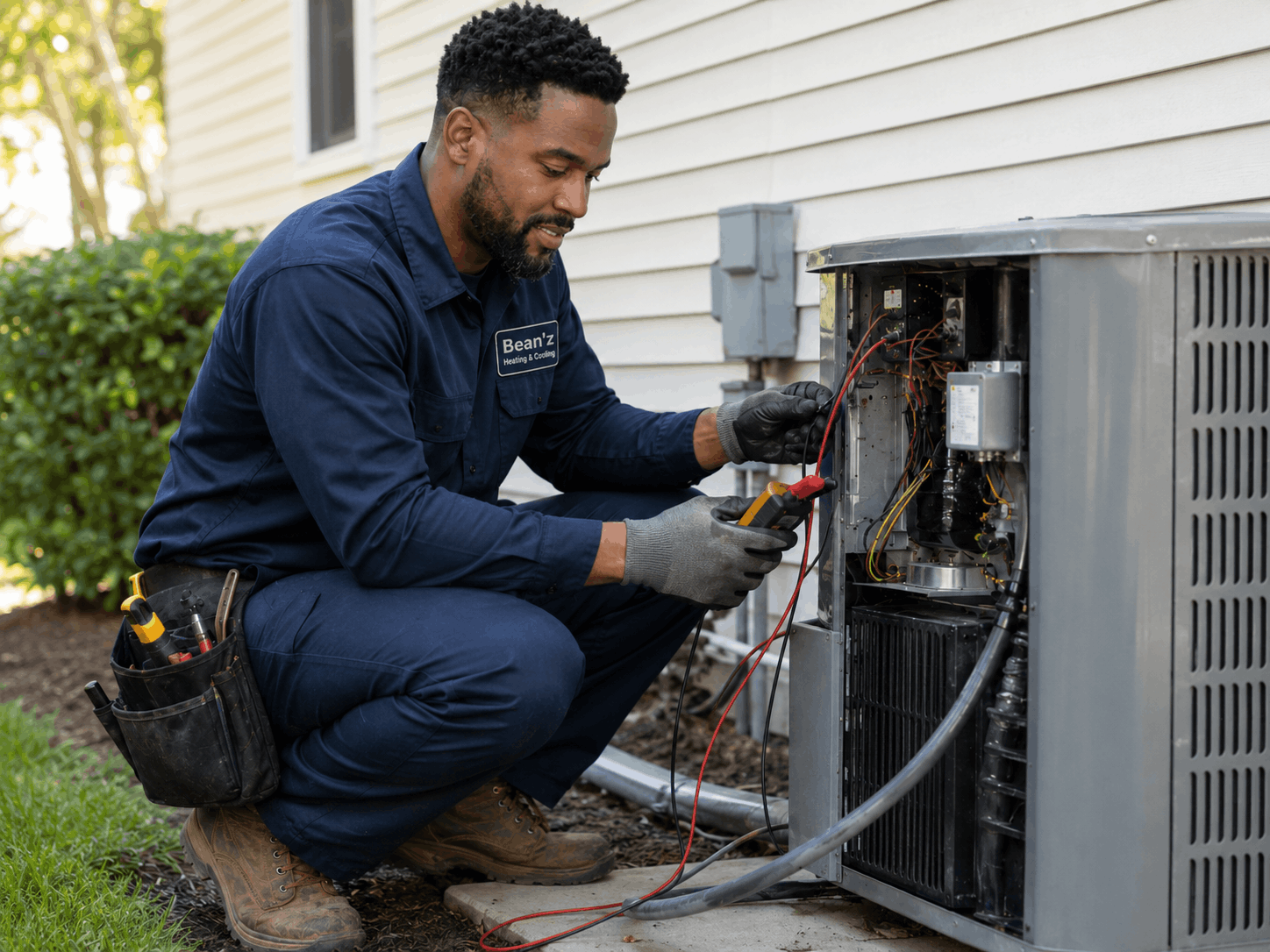
Symptom-to-test map
What AC Repair Chicago IL Complaints Tell Us to Check
The pattern narrows the starting point. Measurements determine whether the problem is electrical, airflow-related, drainage-related, refrigeration-related, distribution-related, or a combination.
Outdoor fan and compressor both off
Start with the cooling call, disconnect and breaker status, low-voltage signal, contactor, safety circuit, wiring, capacitor, and available line voltage.
Outdoor fan runs but cooling is weak
Check compressor operation, coil condition, airflow, indoor temperature change, refrigerant-line temperatures, and applicable pressure, superheat, or subcooling readings.
System cools, then freezes
Review filter restriction, blower speed and motor performance, evaporator condition, duct static pressure, return-air capacity, thermostat operation, and the refrigerant circuit.
Water appears after cooling runs
Inspect the drain pan, trap, drain slope, condensate pump, termination, blockage, coil icing, cabinet pitch, and any overflow or float safety.
One floor stays hot
Compare supply and return paths, damper position, duct leakage, static pressure, register airflow, thermostat location, insulation, sun exposure, and room load.
Unit starts hard or makes a new sound
Observe startup, voltage and current where applicable, capacitor condition, contactor action, motor bearings, fan blade, cabinet vibration, and compressor behavior.
Know what the first charge covers
AC Repair Chicago IL Diagnostic Service Starts at $129
The standard diagnostic covers the testing needed to determine why the system is not cooling and to explain the next step. Parts, refrigerant, repair labor, code corrections, and replacement equipment are separate and require approval.
Confirm the operating complaint
Compare the thermostat request with what the indoor and outdoor equipment actually do, then reproduce the failure when it is safe and practical.
Take targeted readings
Use the symptom to select electrical, airflow, temperature, drainage, control, and refrigerant-side checks instead of replacing a guessed part.
Separate causes from effects
A frozen coil, failed capacitor, hot motor, or open safety can be the result of another condition. We identify visible contributing factors that affect the repair.
Price the approved next step
Bean’z explains the finding, repair scope, known limitations, and price. Added work begins only after you approve it.
Electrical repair and refrigerant diagnosis are different
AC Repair Chicago IL: Test Before Adding Refrigerant
An air conditioner does not become “low on refrigerant” through normal use. The circuit is sealed, so a low-charge condition points to a leak, prior service error, or another loss of refrigerant. Warm air can also come from a failed outdoor electrical component, weak indoor airflow, dirty coils, control trouble, or a compressor that is not operating.
Pressure alone does not prove the charge is correct. Equipment type, refrigerant, indoor and outdoor conditions, airflow, line temperatures, manufacturer data, superheat, subcooling, and system configuration affect interpretation. Refrigerant should not be added until the system and available evidence support that step.
Electrical path examples
A failed contactor, capacitor, fan motor, disconnect, wire, breaker, control signal, or compressor circuit can stop outdoor operation even when the indoor blower still runs.
Refrigeration path examples
Leakage, restriction, metering trouble, coil condition, airflow, improper charge, or compressor performance can change temperatures and pressures while the equipment appears to run.
Decide after the diagnosis
AC Repair Chicago IL or System Replacement?
Many no-cooling calls end with an isolated repair. Replacement becomes a serious comparison when the compressor or coil is damaged, leaks or electrical failures keep returning, compatible parts are difficult to obtain, the system uses costly legacy refrigerant, or the installed equipment cannot meet the building’s cooling needs.
Bean’z compares the immediate repair with the condition of the condenser, indoor coil, blower, ducts, line set, electrical supply, controls, and drainage. The goal is not to replace equipment automatically; it is to avoid spending heavily on one part while ignoring the rest of a failing or mismatched system.
Continue with repair when
The fault is defined, compatible parts or procedures are available, the remaining equipment is serviceable, and the repair supports reasonable continued use.
Price replacement when
The repair is major, failures are repeating, comfort remains poor, or a properly matched new condenser-and-coil project better fits the property plan.
For matched-equipment, line-set, refrigerant, drainage, and startup planning, visit our Chicago AC installation page.
★★★★★“Mr. Bean’z went above and beyond the call of duty. He’s extremely professional, punctual and very affordable. I highly recommend him.”
Cecile Savage
Reduce avoidable cooling shutdowns
After AC Repair Chicago IL service restores operation, homeowners can use the ENERGY STAR HVAC maintenance checklist to understand ongoing filter, coil, drain, and professional maintenance needs.
AC Repair Chicago IL Versus Preventive Maintenance
Choose repair for an active failure
Request AC repair when the system has stopped, is blowing warm air, leaking, freezing, tripping a breaker, making severe noise, or repeatedly shutting down. The first job is to diagnose the present fault.
Choose maintenance for an operating system
Schedule AC maintenance when cooling is functioning and you want the coils, drain, filter, airflow, electrical parts, controls, and operating condition reviewed before peak demand.
For seasonal service and membership benefits, review the Bean’z VIP Comfort Club. For filtration, humidity, or airborne-particle concerns that remain after cooling is restored, visit our Chicago indoor air quality page.
Chicago AC repair questions
Clear AC Repair Chicago IL Answers Before You Schedule
What can I safely check before calling for AC repair?
Confirm that the thermostat is set to cooling, note the displayed temperature, inspect the filter, and observe whether the indoor blower and outdoor unit run. Check a breaker only once. Do not open electrical panels, bypass controls, or handle refrigerant components.
Should I turn the AC off when the coil is frozen?
Yes. Turn cooling off and allow the ice to thaw naturally. Do not chip the ice or apply heat. Note the filter condition, blower operation, and where the ice appears. Water can develop as the coil thaws, so protect finished areas and request service.
Why does my indoor blower run while the condenser stays off?
The thermostat or blower control can operate the indoor fan even when the outdoor circuit has lost power or an electrical, control, safety, motor, capacitor, contactor, or compressor fault prevents condenser operation. Testing is needed to identify which path failed.
Does warm air always mean the AC needs refrigerant?
No. Warm air may come from thermostat settings, outdoor electrical failure, weak airflow, dirty coils, blower trouble, a drain safety, compressor trouble, duct conditions, or refrigerant-side problems. Refrigerant should be evaluated with the complete operating condition.
What is included in the $129 AC diagnostic?
The $129 standard diagnostic covers testing needed to identify the cooling failure and explain the recommended next step. Parts, refrigerant, repair labor, code corrections, and replacement equipment are quoted separately and require approval.
Can Bean’z provide same-day AC repair?
Same-day appointments may be available depending on demand, weather, location, traffic, access, and the time the request is received. Call 312-593-6334 for the current schedule and a realistic service window.
Restore the cooling path
Schedule AC Repair Chicago IL Service
For AC Repair Chicago IL service, tell Bean’z what the thermostat shows, whether the indoor blower and outdoor unit run, which rooms are affected, and whether you see water, ice, noise, odor, or a tripped breaker. We will confirm current availability and explain the $129 diagnostic before dispatch.